The rules that matter on an Australian bike tour are ordinary road rules, a compulsory helmet, a published passing distance in several states, and whatever the trail manager added for the shared path. Everything else is a state page you should open the week you ride. This site will not invent a statute number, a national footpath rule, or a fine that is not on a cited page.
Almost every tour still uses a road. You ride to the trailhead, you cross a highway, you use a quiet connector, or you spend whole Mawson map sections on little-used country roads. The road touring guide is about when that road is a bad idea. This page is about the law and the safety habits that remain after you have chosen a better corridor.
This is not legal advice. If a state page and a paragraph here ever disagree, the state page wins.
Helmets — compulsory, with a short exemption list
Austroads’ helmet-use appendix is the national summary this site uses. It says it is compulsory for bicyclists to wear helmets in Australia, and that where exemptions are possible, applications should be strongly discouraged because of the greater risk of injury and death. The table is the useful part:
- Australian Capital Territory — no bicycle-helmet exemptions.
- New South Wales — no bicycle-helmet exemptions.
- Northern Territory — bicycle helmets are not necessary for people who have attained the age of 17 years and who ride in a public place, on a footpath, shared path or cycle path if separated from the roadway by a barrier, or in an area declared exempt by the transport minister. The NT’s own bicycle-safety page matches the idea: if you are 17 or under you must wear an approved helmet on a public place or footpath; if you are over 17 you are not required to wear one on a public place or footpath unless riding on the road; and it still says it is best to always wear a helmet.
- Queensland — a current doctor’s certificate for medical reasons, or because a physical characteristic makes a helmet unreasonable; and an exemption for a member of a religious group wearing a customary headdress that makes a helmet impractical.
- South Australia — exemptions for Sikh religion only.
- Tasmania — may be considered on medical grounds at the discretion of the Transport Commission.
- Victoria — exemptions possible on religious or medical grounds.
- Western Australia — exemption on medical or religious grounds. A GP medical certificate is part of the process; issue is at the discretion of the Department of Transport. WA’s Road Safety Commission page says you may be exempt if a religious headdress means a helmet will not sit correctly, or if you have a medical reason and a written exemption from the Department of Transport.
Austroads also notes motorcycle-helmet rules in the same table. Those are not this tour. Do not confuse the columns.
Fit is part of the rule in practice. The Northern Territory lists an approved standard label, no damage, a snug fit covering forehead and temples, and a firm chinstrap. Western Australia’s “two fingers” checks — brow gap, V under the ears, fingers under the chin strap — are the same idea in different words. A helmet on the rear rack is not worn. A helmet that has been in a crash is not a spare; WA says replace it.
The Northern Rivers Rail Trail FAQ, writing about a path it treats as a road-related area, says cyclists need to wear a helmet as they would on a road. Shared paths are not a helmet holiday unless you are actually inside the NT adult exception, on the kind of path that exception describes.
Compulsory
Bicycle helmets
Austroads; limited listed exemptions
1 m / 1.5 m
Passing (NSW, SA, NT)
60 km/h split, as published
Left
Ride side
Keep left except to overtake or give way
Passing distances — 1 metre and 1.5 metres where published
Transport for NSW’s sharing-the-road page is written to drivers and is the page a tourer in New South Wales relies on. Bicycle riders have the same rights and responsibilities as drivers and motorcycle riders. Drivers who pass a bicycle rider must allow at least:
- 1 metre when the speed limit is 60 km/h or less
- 1.5 metres when the speed limit is more than 60 km/h
If a driver cannot pass safely, the page says they should slow down and wait. To make the distance possible, NSW describes exemptions — crossing or straddling lines, using a flat painted island or dividing strip — if it is safe and the driver has a clear view of approaching traffic.
That page also publishes a penalty: drivers caught not allowing the minimum distance face a $434 fine and 2 demerit points. We quote those figures because they are on the cited page. They can change. Look at the page, not at this sentence, the week you ride.
South Australia’s cycling-laws page uses the same 1 m / 1.5 m split and applies it to cars, motorbikes, trucks and buses. It allows a driver, if they have a clear view and can do so safely, to drive to the right of centre, cross a dividing line, use a level dividing strip, cross painted-island lines, and straddle or change lanes. It says penalties apply for not keeping the minimum distance, and it does not give an amount on that page — so we do not invent one.
The Northern Territory bicycle-safety page tells drivers to leave at least 1 m when overtaking cyclists if travelling under 60 km/h and 1.5 m if travelling more than 60 km/h, and it lists similar line-crossing exemptions when the view is clear and the move is safe. It notes that cyclists can legally ride two abreast and that they sometimes need to move out to avoid a hazard.
Other states may use the same pair of numbers or a different formulation. Confirm the state page. Do not treat a New South Wales paragraph as a Darwin souvenir.
As a rider, the practical meaning is: hold a predictable line, do not swerve into a pass that has already started, and do not take a road that cannot give you the space. See road touring for when a highway is the wrong tool.
South Australia — footpaths, bells and the rest of that page
The SA cycling-laws page is more than passing distance, and tourers use it as soon as they leave a Riesling cutting for a Clare footpath.
Cyclists of all ages may ride on footpaths unless a sign prohibits it. On a footpath or shared path you must keep left unless it is impracticable, give way to any pedestrian, and give a warning by bell, horn or other means if needed to avert danger. You may ride on the footpath even if there is a bicycle lane on the road. If you ride on the road, you are still required to use a bike lane where one is provided.
In low light, that page says, cyclists must display a white light to the front and a red light and reflector to the rear.
Drivers entering a road from private land or a car park must give way to anyone using the footpath — pedestrians and cyclists. That sentence is how driveway collisions get discussed in official language. Slow down anyway. Assume the driver has not read the handbook this morning.
SA also publishes a “Cycling and the Law Handbook” as the comprehensive rules guide. We point at it rather than pretending this field page replaced it.
Western Australia — a detailed official bicycle page
WA’s Road Safety Commission bicycle-riders page is one of the densest official pages this guide cites. Use it if you ride in WA. Do not assume every bullet is the law in Hobart.
Where you may ride. Any road except a “no bicycles” sign, freeways, and pedestrian malls unless signed otherwise. Any path unless a “no bicycles” or “pedestrians only” sign applies. If a marked bicycle lane is present, you must ride in it.
Lights and reflectors at night or in poor visibility: flashing or steady white front and red rear lights, clearly visible for at least 200 metres; a red rear reflector visible for at least 50 metres in low beam; two yellow side reflectors on each wheel; yellow reflectors on both sides of each pedal. Do not point red lights forward. Do not dazzle people.
Helmets — all bicycle riders, including children and anyone in a trailer, unless an exemption has been granted. WA lists current accepted helmet standards on that page (including AS/NZS 2063:2008 and 2020, EN 1078, US CPSC, ASTM F1447-18, Snell B-95 1998 revision) and notes older standards that have been phased out. We are not a standards shop. Look at the sticker and the page.
Bike equipment. At least one working brake; an effective warning device; a load no more than 800 mm wide.
Group and traffic behaviour. Two abreast on roads with up to 1.5 m between riders; single file on paths; at least 2 metres behind a vehicle; do not pass on the left of a vehicle that is turning left; left lane of a roundabout may be used when turning right if you give way to vehicles exiting.
Paths and crossings. Give way to pedestrians, including mobility scooters and wheelchairs. Bell before you overtake. When riding across a pedestrian crossing from the connected path, give way to pedestrians and slow to 10 km/h or less. Animals must not be tied to a moving bike.
Passengers. Do not carry more people than the bicycle is designed for. Child seats and trailers have age and design conditions on that page; the rider must be at least 16.
E-bikes. See e-bike touring. WA’s own summary: 16 or older; motor up to 250 W for an EN 15194 Pedalec with assistance cutting at 25 km/h; 200 W for other power-assisted pedal cycles; human power required; non-compliant machines treated as unlicensed motor vehicles.
Penalties on that page. WA publishes a short table. We quote it because it is there: not wearing a helmet $50; no effective brake and warning device $100; incorrect lighting $100; not riding only two abreast as specified $50; riding less than 2 m behind a vehicle $100; passing on the left of a left-turning vehicle $100. A separate $500 figure appears for using a non-compliant e-bike. Amounts change. The live page wins.
The same page states that between 2019 and 2023, 428 bicycle riders were killed or seriously injured in collisions with motor vehicles on WA roads. That is why the passing and visibility rules exist. It is not a reason we will invent a national crash statistic.
Northern Territory — equipment, remote riding, road trains
The NT bicycle-safety page is the official remote-touring page as much as it is a town-rules page.
Minimum equipment: a bell or horn in good working order; a white front reflector; working brakes; a red rear reflector. At night: white front light and red rear light. In poor conditions the page specifies flashing or steady lights visible for at least 200 m and a rear reflector visible for at least 50 m.
On the road: at least one hand on the bars; sit astride facing forward unless the bike is designed otherwise; ride on the left unless overtaking or giving way to pedestrians; no more than two abreast; use signals; keep more than 2 m from the rear of a vehicle; do not hold a moving vehicle; do not overtake on the left of a vehicle indicating left; left lane of a roundabout when turning right if you give way to exiting traffic; helmet if you are under 17 or if you are on the road.
On a path: keep left of oncoming riders and pedestrians; give way to pedestrians; use the bell. You may ride slowly — walking pace — across a children’s or pedestrian crossing, giving way, and only on a green bicycle or pedestrian light at a signalised crossing.
Remote areas: towns and communities may be hundreds of kilometres apart. Plan water and services, allow time for repairs, check road and weather, wear a helmet and sun-protective clothing, be aware of road trains and heavy vehicles, carry a repair kit and food, stay hydrated, and avoid riding at night. Heavy vehicles need more room to turn and have blind spots; do not sit on the inside of a turning truck.
Those remote-area sentences are why a Stuart Highway fantasy is usually a bad tour. They are also why a personal locator beacon belongs on a long NT or outback plan even though no road rule named it.
Shared paths, rail trails and the extra rule sheet
State road rules do not expire when the surface turns to granite. Trail managers add manners that function as conditions of use.
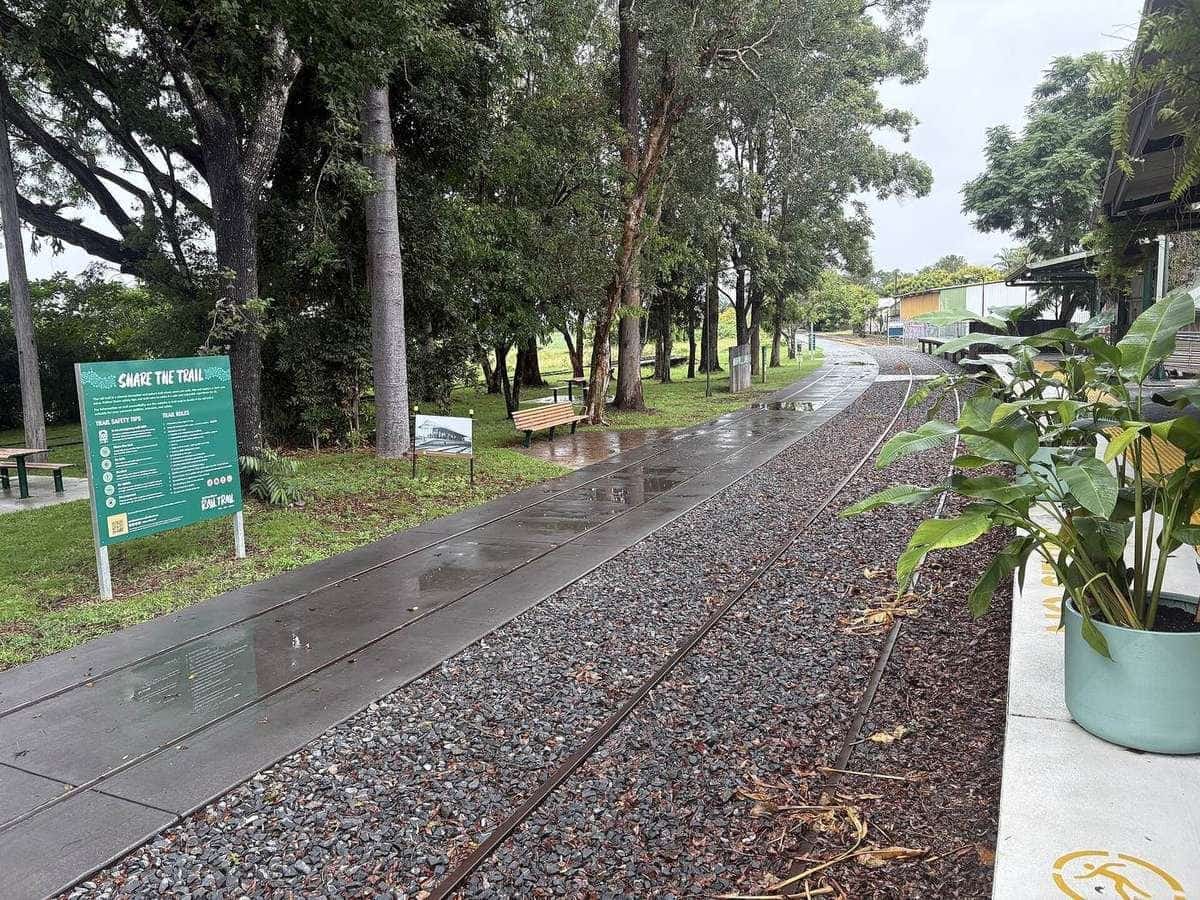
The Northern Rivers FAQ is the worked example: helmets; bells and safe speeds; no posted numeric limit; pedestrians have priority in the shared language of that site; dogs on short leads; horses only in designated areas; bikes give way to horses; horses and bikes give way to pedestrians; lights if you are there at night, which they discourage; no camping; no smoking; no fires; dismount and dark-tolerant behaviour in tunnels that are microbat and glowworm habitat.
ORSR’s Mawson shared-trail notes: slow or stop when passing; alert people from behind; horses have right of way over other trail users. Gates and stock are ordinary rural law in spirit: leave gates as you find them, do not scatter cattle for a photograph.
Keep left. Pass wide. Talk to a horse rider. None of that is optional if you want the corridor to stay open.
Heat, fire, flood and wildlife — safety that is not a statute number
Rules keep you legal. Touring still fails on weather and remoteness.
Heat. Ride early. Carry more water than a city loop taught you. Know the ordinary signs of trouble — headache, dizziness, nausea, cramps — and stop. BOM heatwave advice is the official weather voice; see seasons. We will not invent a stop-now temperature.
Fire. Parks and forests close on Total Fire Ban days. ORSR says the public must not enter, and to call 000 to report a fire. Closed means closed, including the “we will just ride the edge” idea.
Flood. Unsealed trails close after rain. Never ride into floodwater.
Wildlife and stock. Kangaroos at dawn and dusk, snakes in warm weather, magpies in spring, cattle on a Brisbane Valley verge. Slow down. Give space. Cable ties on a helmet are folklore that some riders use; they are not an official standard.
Remoteness. Tell someone the plan. Carry a messenger that works without mobile coverage on Mawson and Munda sections. The NT page’s remote list is the national common sense in official clothes.
Equipment that is both law and touring sense
Pack as if the state will ask and as if the tunnel will be dark:
- approved helmet, fitted and fastened
- working brakes
- bell or horn
- white front and red rear lights, plus reflectors as that state lists them
- a load that does not flap, sway or overhang into a driver’s path (NT language) and is not wider than a page such as WA’s 800 mm figure
- visibility in poor light — WA suggests bright or reflective clothing without making it mandatory
The packing guide is the bag. This page is why some of the bag is not optional.
A method for staying legal on tour
- Write the states you will ride through, not the state you booked the flight in.
- Open helmet, passing-distance, footpath and light pages for each. Start with Austroads, TfNSW, SA cycling laws, WA RSC, NT bicycle safety.
- Open the trail manager for path-only rules (e-bikes, horses, tunnels, fires).
- Fit the helmet on the people in the group, including children and trailer passengers.
- Ride on the left as if a visitor is about to look the wrong way — because someone is.
- Hold a predictable line so a driver can give the published metre.
- Re-check closures the morning you ride through forest.
Road rules checklist
0 of 7 done
Ticks are saved in this browser only.
Related reading
Road touring for when a highway is the wrong place to apply these rules. E-bike touring for the power-assisted definition. Seasons for fire and heat. What to pack for the kit. Editorial policy for why this page refuses invented penalties.
Frequently asked questions
Do cyclists have to follow road rules in Australia?
Yes. On the road a bicycle is a vehicle. Western Australia’s Road Safety Commission says laws that apply to vehicles apply to cyclists unless they are expressly excluded. The Northern Territory says cyclists have the same rights and responsibilities as other road users and must obey the road rules.
Are bicycle helmets compulsory?
Yes, in Australia. Austroads states that it is compulsory for bicyclists to wear helmets, and it tables the limited exemptions: an NT adult path exception, a South Australian Sikh exemption, and some medical or religious exemptions in other jurisdictions. Wear an approved, fastened helmet unless you hold an exemption that applies where you are.
What passing distance must drivers give bicycle riders?
Transport for NSW says drivers must allow at least 1 metre when the speed limit is 60 km/h or less and 1.5 metres when it is more than 60 km/h. South Australia’s cycling-laws page and the Northern Territory’s bicycle-safety page publish the same split. Confirm any other state on its own page.
Can I ride on the footpath?
It depends on the state. South Australia allows cyclists of all ages on footpaths unless a sign prohibits it. Western Australia allows path riding unless signed otherwise. Do not export one state’s footpath rule to another.
What lights do I need?
Night-riding rules are state-based and similar in spirit. The Northern Territory requires a white front light and a red rear light at night, plus a white front reflector, a red rear reflector, working brakes and a bell or horn. Western Australia specifies lights visible for at least 200 metres and a longer reflector list. Carry lights on tour anyway.
Will this page quote every state’s fine?
No. We only quote a penalty if it appears on a page we cite. Transport for NSW publishes a passing-distance penalty on its sharing-the-road page. Western Australia publishes a short cyclist-offence table. Other amounts stay off this page until we can cite them.
Sources and further reading
Facts on this page were checked against these primary and official sources. Conditions change — confirm before you travel or buy.
- Helmet use — Austroads
- Sharing the road — Transport for NSW
- Cycling laws — Government of South Australia
- Bicycle riders — Government of Western Australia
- Bicycle safety — Northern Territory Government
- Northern Rivers Rail Trail FAQ — Northern Rivers Rail Trail