Gravel touring in Australia is a multi-day dirt ride with a bed at the end of it, not a downhill park with a chairlift. The surface might be granite on an old railway, pea gravel in a Western Australian forest, or a farm track that South Australia’s trail managers still call a road. The sport is still touring: pace, water, weather, and the next town.
This guide is the menu for unsealed riding on this site. It is not a ranking of trails and it does not sell a supported product. Lengths and surfaces come from Rail Trails Australia, the Munda Biddi Trail Foundation, and the South Australian Office for Recreation, Sport and Racing (ORSR). If two official pages disagree by a kilometre, we show the range.
What belongs in this category
Three kinds of ride sit under “gravel” here, and mixing them up is how people pack the wrong bike.
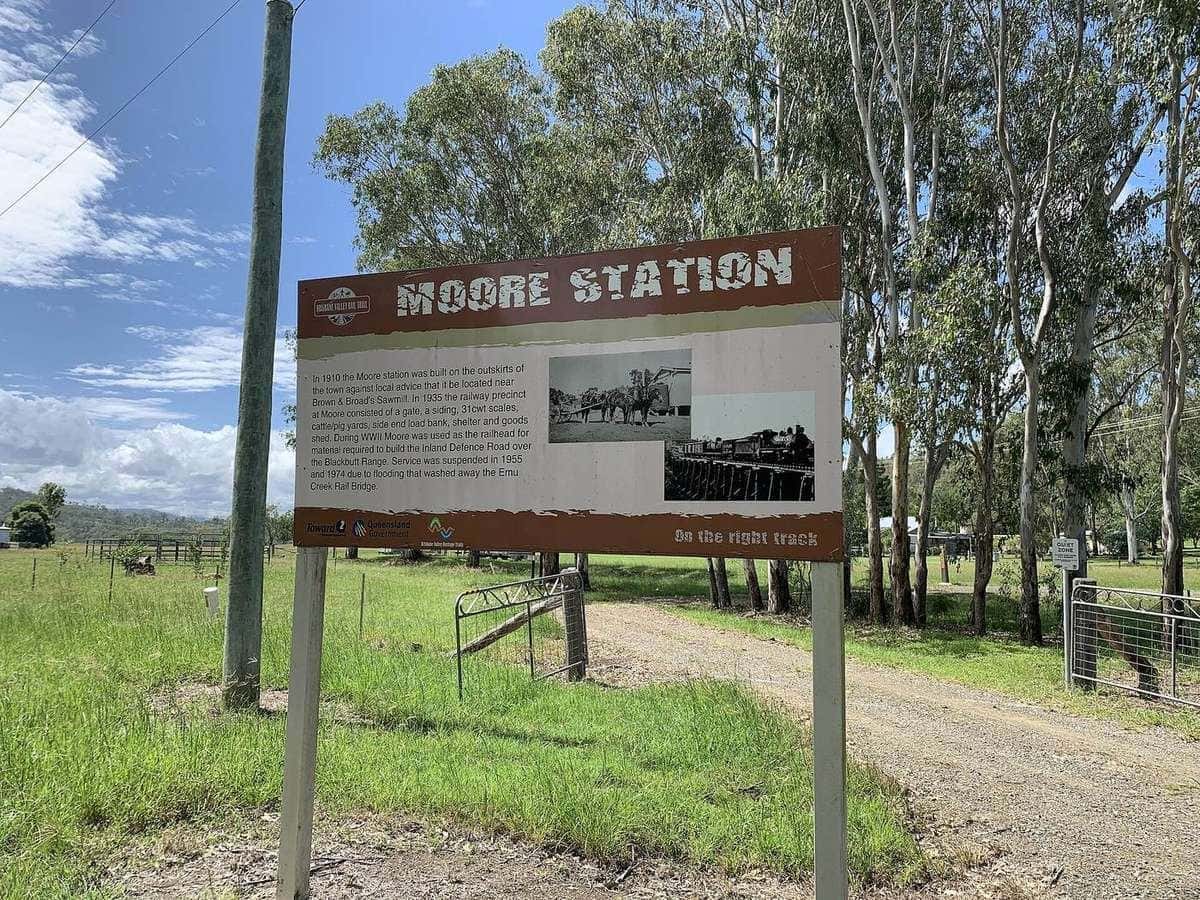
Unsealed rail trails reuse a railway formation. The grade is still a train grade. The towns are still station towns. The surface is gravel, decomposed granite, compacted earth, or a mix with sealed pieces through town. Rail Trails Australia lists the Brisbane Valley Rail Trail at 161 km from Wulkuraka to Yarraman, with coarse gravel, compacted earth, fine gravel and sealed sections. It lists the Great Victorian Rail Trail at 134 km in the trail description and 135 km in the length field — same corridor, two figures on one inventory page — from Tallarook toward Alexandra and Mansfield, compacted earth and fine gravel. The Riesling and Rattler listing is 53 km of fine gravel from Riverton to White Hut in the Clare Valley.
Long official dirt touring routes were never a single railway. The Munda Biddi Trail Foundation describes a 1,072 km off-road adventure trail from Mundaring to Albany. ORSR describes the Mawson Trail as close to nine hundred kilometres from just north of Adelaide to Blinman, on little-used country roads, forest and park tracks, farm access, unused road reserves, and only small sections of sealed road and singletrack. Those are expeditions you can still ride in pieces.
Quiet unsealed farm roads that you add yourself are the riskiest of the three, because nobody published a map section or a water note for your shortcut. Use them only as connectors you have checked, not as a substitute for an official route.
What does not belong:
- downhill parks, jump lines, bike-park shuttles, and “flow” marketing
- sealed-only touring (that is the road touring page)
- a highway with a gravel shoulder you decided to romanticise
161 km
Brisbane Valley
RTA: longest listed rail trail
1,072 km
Munda Biddi
Foundation, Mundaring to Albany
~900 km
Mawson Trail
ORSR: close to nine hundred
This is touring, not a downhill brief
The Munda Biddi and the Mawson attract the same photographs as adventure mountain biking: forest, dust, a loaded bike. They are still touring routes. You are trying to cover country and sleep. You are not trying to send a feature.
The Foundation is explicit about what the Munda Biddi is: an off-road adventure cycling and bikepacking trail, mostly away from motorised vehicles and busy highways, made of natural surfaces, with rail-trail sections, singletrack and forest roads. It recommends some mountain-biking or gravel-biking experience if you want to enjoy it. That is a touring competence note, not a park grading.
ORSR is equally plain about the Mawson. You need an off-road bicycle. Heavy rain on unmade tracks can make cycling very slow or impossible. Some climbs are steep. Under the Australian mountain-bike trail guideline’s difficulty language, ORSR says the Mawson would classify as easy or intermediate — which is a trail-rating sentence, not an invitation to treat Blinman as a bike park.
If you arrived here looking for Derby-style jump networks or a downhill guide, this is the wrong site. We will keep saying that until the search snippet is unambiguous.
Surfaces, in the order you will meet them
Fine gravel and decomposed granite (Riesling, many Victorian rail trails on a dry week) reward a hybrid or gravel bike with tyres in the mid-thirties of millimetres and up. They still hide sharp ballast and the occasional hole where a culvert slumped.
Coarse gravel and earth (much of the Brisbane Valley away from the concreted town pieces) punish a road tyre and reward tread, slower cornering, and a willingness to walk a cattle grid. Rail Trails Australia notes that surfaces vary, that some sections need an off-road bike and competency on unsealed surfaces, and that pieces can close after high rainfall.
Pea gravel on the northern Munda Biddi, as the Foundation describes the Mundaring-to-Manjimup country, is a distinctive red surface that moves under a narrow tyre and under a hurried line. It is why “I ride gravel at home” is not the same as “I have ridden this forest”.
Loam and fine white sand on the southern Munda Biddi, Mundaring’s opposite end toward Albany, is a different problem again. Sand after a dry spell, loam after rain. Choose a section that matches the bike you packed, not the section that looked green in a photograph.
Farm tracks and unmade road reserves on the Mawson add gates, stock, and the chance that yesterday’s firm wheel track is today’s bog. ORSR tells you to take an alternative if extreme conditions make a dirt track impassable. That sentence is the whole method.
After rain, unsealed formations go soft. After a long dry, they corrugate and throw stones. Neither condition is a reason to invent a monthly average. Check the manager and the Bureau of Meteorology town forecast the week you leave. See seasons.
Bikes that match the dirt
Match the most delicate tyre in the group to the coarsest official surface on the day, not the other way around.
- Fine-gravel rail trail, towns every couple of hours: hybrid, gravel, or a sturdy touring bike. The Riesling Auburn–Clare piece is the gentle version of this sentence.
- Mixed rail trail with coarse sections: gravel or mountain bike. The Brisbane Valley listing is not a road-bike advertisement. RTA says so in the suitability list.
- Mawson: ORSR — off-road bicycle; mountain bike or sturdy touring bike; not a road bike.
- Munda Biddi: Foundation — mountain-bike or gravel experience recommended; natural surfaces; varied terrain.
An e-bike that stays inside the legal power-assisted definition can be a gravel-touring bike on a trail that allows it. The Northern Rivers Rail Trail FAQ allows e-bicycles up to 250 W; that is a sealed-and-compacted example, not a national dirt rule. Confirm the trail manager. A throttle-only scooter is not a touring bicycle. See e-bike touring.
Service the bike before a dirt week. Carry a puncture kit you have used, not one you bought at the airport. Remote routes add a spare hanger, more tubes than pride suggests, and the humility to walk.
How a gravel rail trail differs from a long dirt route
A rail trail still does the social work of a railway. You pass a bakery because a station needed a town. You can usually abort to a road. The Brisbane Valley’s former station sites are the access points Rail Trails Australia names; drinking water and toilets are described as available in the towns. That is a touring convenience, not a promise that every tap works on a 40-degree afternoon.
A long dirt route does less of that work. ORSR says reliable water supplies in country areas cannot be guaranteed on the Mawson, that mobile coverage is limited in many areas, and that you should travel in a group of three or more. The Munda Biddi Foundation describes purpose-built forest shelters every 40–60 km, with tanks, and a partnership with the Parks and Wildlife Service (DBCA). Those sentences change the packing list. They do not change the fact that both rides are touring.
If you are new to dirt with luggage, ride an unsealed rail-trail section first. The Great Victorian’s farmland pieces, when they are open, teach you corrugations and shared-path manners without asking you to carry two days of water. Then open the Mawson or Munda Biddi field guides if you still want the longer sentence.
Sharing dirt with other users
Gravel touring is almost never private. Rail trails are shared with walkers, sometimes horses, sometimes dogs on leads. Forest roads are shared with park traffic. Farm tracks are shared with the person who owns the gate.
ORSR’s shared-trail notes for the Mawson are a decent default even when you are not in South Australia: slow or stop when passing; alert people from behind; walkers keep left where they can; horses have right of way over other trail users. The Northern Rivers FAQ, on a different surface, is explicit that bikes give way to horses and that horses and bikes give way to pedestrians in shared areas. None of that is optional politeness. It is how corridors stay open.
Gates: leave them as you find them. Stock: slow down, do not scatter a mob for a photograph. Cattle grids: treat them as a skill, not a sprint. Tunnels on rail trails: light on, noise down, dismount where the manager asks — the Northern Rivers tunnels are habitat, not a pump track.
Navigation on surfaces that look the same
Railway formations are easy to over-trust. A gravel path that looks like the trail can be a private farm lane. Official markers exist because of that.
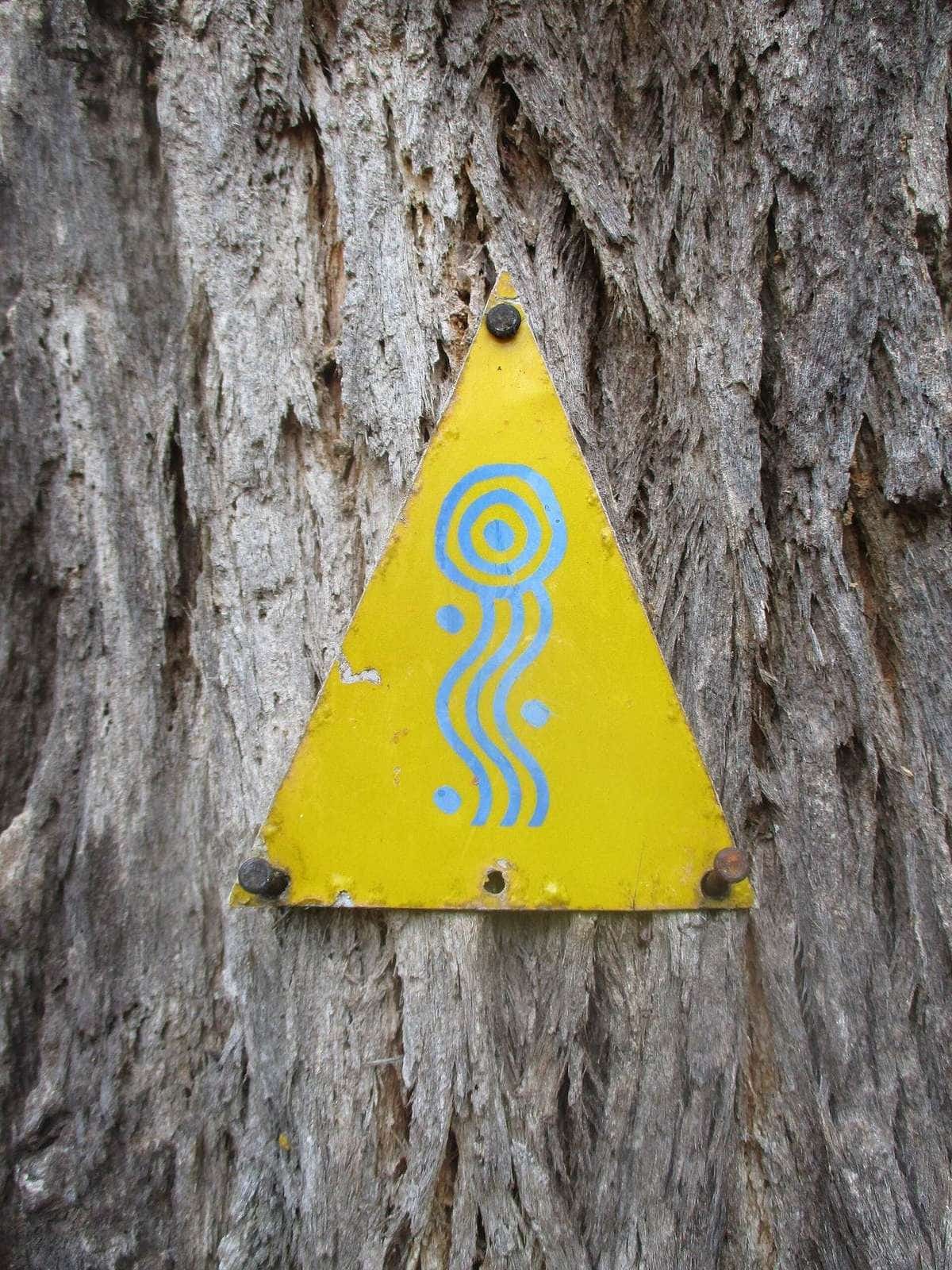
The Mawson is marked, ORSR says, with a beige and purple marker — trilobite, bike wheel, gum leaf — and a white directional arrow, with newer yellow posts and reflective plates on some sections. Markers sit at junctions and where the trail turns, and about every 1–2 km on straight pieces. Carry the map section anyway. ORSR sells the idea of nine annotated maps; Mapland in Adelaide and Bicycle SA are the printed-map outlets that page names.
The Munda Biddi is a marked forest trail with a Foundation app and maps in the wider planning kit. Mobile coverage is not a plan. A downloaded map and a person at home who knows the day’s intention are the remote-touring minimum.
Rail trails are usually the easiest to follow and still have town crossings where the formation was sold. Follow the signs through Myrtleford-style gaps; do not invent a highway alternative because you lost the easement for four blocks.
Water, heat and the dirt-road version of remoteness
Dirt touring fails on water more often than it fails on gradient. Bitumen towns are closer together because roads follow settlement. Some dirt routes follow the country that settlement skipped.
ORSR’s Mawson water advice is the one to steal: enough water on the bike for the riding, more in the bags for camp, never drink from creeks and waterholes, and consider a support vehicle in excessive heat. The Foundation’s Munda shelters have two tanks each — which is a facility, not a guarantee after a dry spell or a busy week. Rail-trail towns are easier, and still not a reason to roll out of Esk or Yea with a single bottle in January.
Heat on gravel has less shade than marketing photos suggest. South-east Queensland summers are hot and humid; inland South Australia can be fiercely hot in the months ORSR tells you to avoid. The Bureau of Meteorology climate pages are the planning source; we will not invent monthly averages. Fire danger is a closure problem as much as a comfort problem. See seasons.
Packing for dirt without turning the bike into a trolley
The packing guide is the list. The gravel-specific argument is weight placement and spare traction.
Bikepacking bags keep the load inside the triangle and off a rack that can snag on brush. Panniers still work on many rail trails and on firmer Mawson roads if the racks are honest and the bags are not wider than the bars. Western Australia’s bicycle-standards note that a load on a bicycle cannot be more than 800 mm wide — a rare official width figure, and a hint that a barn-door pannier setup is not a road-legal decoration.
Carry a plug kit if you run tubeless, tubes if you do not, and the tool for the axle you actually have. Remote days add a first-aid kit and a messenger that works without mobile coverage. ORSR asks you to let someone know the plan. Do that.
We will not rank a bag brand or invent a price.
A method for choosing the first gravel tour
- Name the surface from an official page, not from a memory of “it looked pretty packed”.
- Name the longest gap between services. If you cannot name it, you are not ready for that section.
- Pick the bike for the coarsest kilometre, not the town main street.
- Read fire, flood and closure notes the week you leave. The Great Victorian’s fire notice is the exhibit.
- Decide whether you want railway towns or forest camps. That is the rail-trail versus Munda/Mawson fork.
- Leave the downhill park out of the itinerary. Different sport, different site.
Gravel touring checklist
0 of 7 done
Ticks are saved in this browser only.
Related reading
Field guides: Brisbane Valley, Great Victorian, Riesling Trail, Mawson Trail, Munda Biddi. If the group still has road bikes in the shed, go back to road touring and the Murray to Mountains. Planning constraints live under seasons and what to pack.
Frequently asked questions
What is gravel touring in Australia?
Multi-day riding on unsealed rail trails, forest roads, farm tracks and official long-distance dirt routes. The Brisbane Valley Rail Trail, the Great Victorian Rail Trail, the Mawson Trail and the Munda Biddi Trail are the examples this site documents. It is touring on dirt, not a downhill-park sport.
Do I need a mountain bike?
On remote official routes, often yes. South Australia’s Office for Recreation, Sport and Racing says you need an off-road bicycle for the Mawson Trail. The Munda Biddi Trail Foundation recommends mountain-bike or gravel experience. Fine-gravel rail trails can suit a hybrid with wider tyres.
Is the Munda Biddi a downhill trail?
No. The Foundation describes a 1,072 km off-road adventure cycling trail from Mundaring to Albany, with rail-trail pieces, singletrack and forest roads. This site treats it as touring. Jump lines and bike parks belong elsewhere.
What surface should I expect on an unsealed rail trail?
It depends on the listing. Rail Trails Australia describes the Brisbane Valley as coarse gravel, compacted earth, fine gravel and sealed town sections, and the Great Victorian as compacted earth and fine gravel. After rain, unsealed formations go soft. Check the manager.
Can I ride a road bike on gravel trails?
Not as a plan. Narrow road tyres belong on the sealed Murray to Mountains listing, not on the Brisbane Valley’s mixed gravel. If the most delicate bike in the group is a road bike, pick a sealed trail instead.
How do I choose between a gravel rail trail and a long dirt route?
Town spacing and rescue. A rail trail still has settlements where stations were. The Mawson and the Munda Biddi include remote stretches, water planning and fire closures. Start with a rail-trail section unless you already ride dirt with luggage.
Sources and further reading
Facts on this page were checked against these primary and official sources. Conditions change — confirm before you travel or buy.
- Brisbane Valley Rail Trail — Rail Trails Australia
- Great Victorian Rail Trail — Rail Trails Australia
- Riesling and Rattler Trails — Rail Trails Australia
- About the trail — Munda Biddi Trail Foundation
- Mawson Trail — Office for Recreation, Sport and Racing (SA)
- Climate data — Bureau of Meteorology